
AMD Helios MI450 Rack Unveiled at OCP Summit by Meta
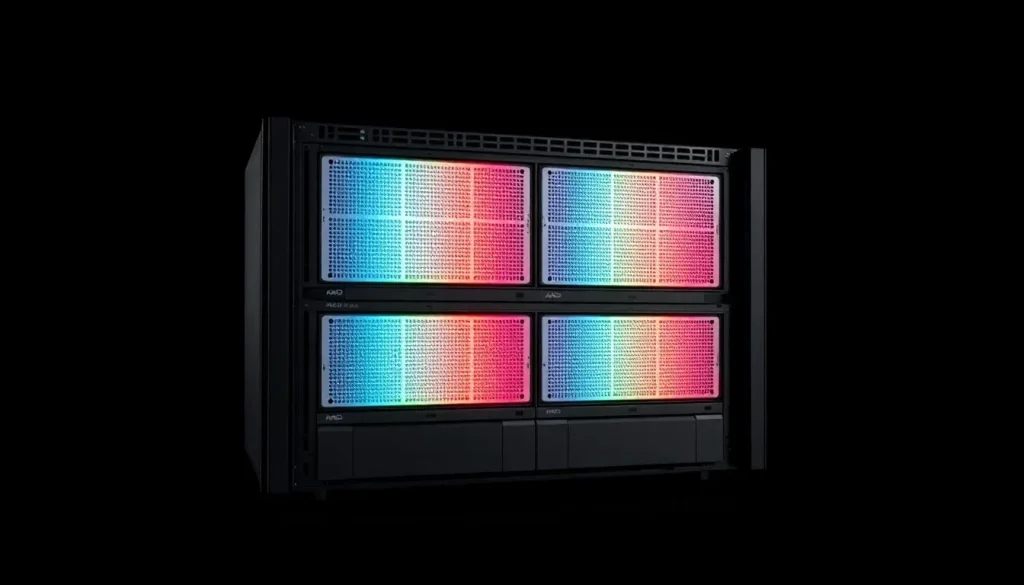
This week marked a significant moment for AMD, as the company unveiled a series of exciting developments surrounding their Helios AI racks. Among the announcements was a monumental 50,000 GPU partnership with Oracle, which highlights AMD's ambition in the AI sector. Furthermore, at the OCP Summit 2025, attendees were treated to a first look at the reference AI rack from AMD, alongside a distinct version designed by Meta, showcasing notable differences that could influence future AI infrastructure.
Exploring the AMD Helios MI450 Reference Rack at OCP Summit 2025
The AMD Helios MI450 rack was a highlight at the OCP Summit 2025, drawing considerable attention from industry professionals and enthusiasts alike. The reference photo captured before the official opening showcased a sleek design, revealing the intricate layout of the rack that would soon be surrounded by eager onlookers.
Notably, the rack features a robust management switch positioned at the top, with power distribution components strategically placed below. This thoughtful arrangement emphasizes not only functionality but also the ease of access for maintenance and upgrades.
A closer examination of the power shelves reveals the compute nodes housed beneath them. One of the defining characteristics of this rack is its compliance with OCP standards, specifically the ORv3 wide rack specifications.
In the center of the setup are the switches, reminiscent of NVIDIA’s design that incorporates compute trays above and below their switch trays. This similarity indicates a trend in rack design that prioritizes efficient cooling and space utilization.
One can’t help but notice the sturdy handles on the switch trays, a design choice made by the engineering teams that AMD acquired through their ZT Systems acquisition. This robustness suggests a focus on durability, ensuring that the hardware can withstand the rigors of intensive AI workloads.
Among the notable features are optical connections that appear to be compatible with NVIDIA standards. Additionally, the compute trays demonstrate a strategic layout where only one of the two OCP NIC 3.0 slots is utilized, highlighting the transition to newer technologies. The EDSFF E1.S SSDs are prominently displayed on both sides, signifying the shift away from older PCIe Gen6 generation 2.5″ U.2 connectors.
Key Features of the AMD Helios MI450 Rack
- OCP Compliance: The rack is designed to meet Open Compute Project standards, ensuring interoperability and efficiency.
- Power Distribution: Multiple power shelves are strategically placed to optimize energy management.
- Robust Design: Heavy-duty handles and durable components reflect a commitment to long-term reliability.
- Advanced Connectivity: Incorporates NVIDIA-like optics and EDSFF SSDs for enhanced data transfer rates.
- Efficient Cooling: The layout is tailored to promote airflow and thermal management.
The Impact of AMD's Helios Technology on AI Infrastructure
As AI continues to evolve, the infrastructure that supports it must also adapt. AMD's Helios MI450 rack is a testament to this evolution, offering a solution that caters to the demanding needs of AI workloads. By integrating high-performance computing with an optimized design, AMD is positioning itself as a leader in the AI hardware market.
This transition to advanced AI racks comes at a pivotal time when organizations are increasingly reliant on AI for various applications, from data analysis to machine learning. The Helios series not only provides the necessary hardware but also embraces scalability, allowing businesses to grow their AI capabilities without the need for complete overhauls of their systems.
Comparison with Meta's Version of the Helios Rack
At the same event, Meta showcased its version of the Helios rack, which presented several contrasting features to AMD's offering. While both racks share the Helios branding, the differences in design and specifications could lead to distinct advantages depending on the use case.
Some key differences include:
- Cooling Solutions: Meta's rack might incorporate unique cooling technologies that differentiate its performance during peak workloads.
- Network Architecture: Variations in network configuration could affect data throughput and latency, crucial factors for real-time AI applications.
- Modular Design: The extent to which each rack offers modular components may influence future upgrades and maintenance ease.
Future Prospects for AMD and AI Technology
Looking ahead, AMD's commitment to advancing AI technology is clear. The introduction of the Helios MI450 rack is just the beginning, with plans for further innovations expected as the demand for AI solutions escalates. The anticipated launch of additional AI racks by 2026 indicates that AMD is strategically positioning itself to meet the growing needs of businesses leveraging AI across industries.
Furthermore, partnerships with leading tech companies will likely enhance AMD’s capabilities, allowing them to deliver cutting-edge solutions that cater to diverse applications. As AI becomes increasingly embedded in everyday operations, the significance of robust, efficient hardware cannot be overstated.
In conclusion, the AMD Helios MI450 rack and its counterpart from Meta embody the future of AI infrastructure, merging high performance with innovative design. These advancements not only promise to elevate the capabilities of AI applications but also set a new standard for what organizations can expect from their hardware solutions.


Leave a Reply