
Discovery of Possible First Stars Powered by Dark Matter
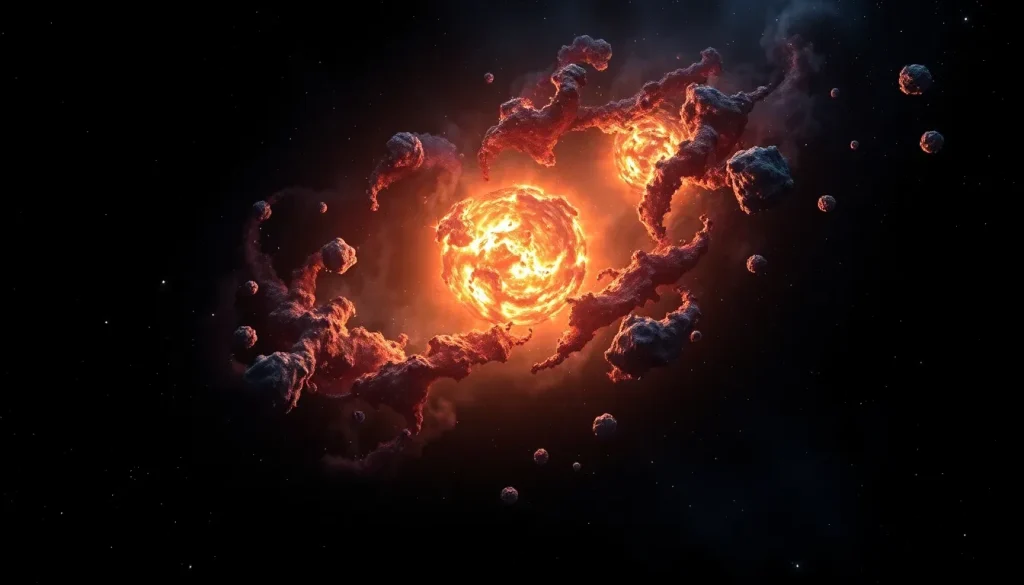
The universe is a vast expanse filled with unsolved mysteries, one of which is the enigmatic phenomenon of dark matter. It is estimated to constitute about 25% of the universe's total mass, yet its true nature remains shrouded in mystery. This elusive substance neither absorbs nor reflects light, making it incredibly difficult to detect directly. Instead, it subtly influences the gravitational forces that shape galaxies and clusters of galaxies. Among the intriguing theories surrounding dark matter is the possibility of the existence of dark stars, massive celestial bodies that could derive their energy from dark matter rather than the traditional nuclear fusion processes that power ordinary stars.
Recent advances in astronomical observation, particularly with the James Webb Space Telescope, have sparked excitement in the scientific community. In 2023, a team of researchers announced what they believe could be the first detection of these mysterious dark stars. Although further investigation is needed to confirm this finding, their research offers tantalizing evidence that these stars may indeed exist. The implications of such a discovery could be profound, not only for our understanding of stars but also for our grasp of dark matter itself.
How do stars form, evolve, and ultimately die?
Traditionally, the formation of a star is understood as a process where a large mass of relatively cool gas collapses under its own gravity, leading to an increase in temperature. This initial phase triggers nuclear reactions within the star, where hydrogen nuclei fuse with deuterium nuclei, creating helium and releasing vast amounts of energy in the process. This phenomenon is known as nuclear fusion.
Initially, hydrogen and deuterium serve as the primary fuel sources for stars. However, just as a vehicle runs out of gasoline, stars eventually exhaust these fuels. The first to deplete is deuterium, which leads hydrogen to react with lithium and other lighter metals. As these sources run low, stars must resort to alternative fusion processes, such as the nitrogen and oxygen catalytic reaction, which allows helium to continue forming from hydrogen.
Eventually, the star is left with a core primarily composed of helium. At this point, the star enters a phase of expansion and cooling, becoming what is known as a red giant. If the star can no longer generate energy, it may either shrink into a white dwarf or collapse dramatically, resulting in a neutron star, a supernova, or a black hole, depending on its mass.
What are dark stars like?
In 2023, astronomers identified three celestial objects that defy traditional definitions of stars. These entities are notably larger than our Sun, possess an extraordinarily bright luminosity, and are located at significant distances from Earth. Specifically, they are believed to have formed only a few hundred million years after the Big Bang, which occurred approximately 13.8 billion years ago. Thus, these stars are among the earliest to have emerged in the universe's history.
Due to the immense distances involved, the light from these stars takes considerable time to reach our telescopes. Only advanced instruments, such as the James Webb, are capable of probing these remote corners of the universe. Initially mistaken for galaxies, further analysis revealed these objects to be unique stars. Their existence challenges our understanding of stellar formation, as they cannot be explained solely by the conventional processes relying on hydrogen and deuterium.
Instead, they align with the concept of dark stars, first proposed in 2008 by astronomers Doug Spolyar and Paolo Gondolo. These stars would derive their energy from dark matter interactions. Although the precise composition of dark matter is still unknown, it is theorized that it may consist of yet undiscovered elementary particles. One leading candidate is Weakly Interacting Massive Particles (WIMPs). When these particles collide, they annihilate each other, generating heat in the surrounding hydrogen clouds, which subsequently collapse to form luminous dark stars.
Recent discoveries about dark stars
Following the initial findings, the research team from Colgate University and the University of Texas at Austin employed additional instruments aboard the James Webb to analyze the spectra of the three candidates for dark stars. Their investigation revealed that one of the objects might not be a dark star at all but rather a very distant supermassive star. However, the other two candidates exhibited characteristics that align perfectly with the current definition of dark stars.
These colossal stars could potentially collapse into the most distant black holes, thereby providing new insights into their origins and the broader context of cosmic evolution. The existence of dark stars, if confirmed, would serve as a compelling piece of evidence for the reality of dark matter. It would demonstrate that, while we cannot directly observe dark matter, it plays a crucial role in the cosmos, even fueling stars that do not rely on conventional nuclear fuels.
As we continue to explore the universe, the prospect of uncovering more about dark stars and their relationship with dark matter opens new avenues for understanding the fundamental nature of the cosmos. Each discovery brings us closer to unraveling the intricate web of mysteries that govern our universe.
For those interested in visualizing this groundbreaking research, here’s an informative video that discusses the potential existence of dark stars:
The ongoing search for dark stars exemplifies the dynamic nature of modern astrophysics, where each new observation challenges existing paradigms and invites fresh questions. As we push the boundaries of our knowledge, the universe continues to reveal its secrets, demonstrating that our quest for understanding is far from over.



Leave a Reply