
Meteorite possibly hits Tesla, car continues driving normally
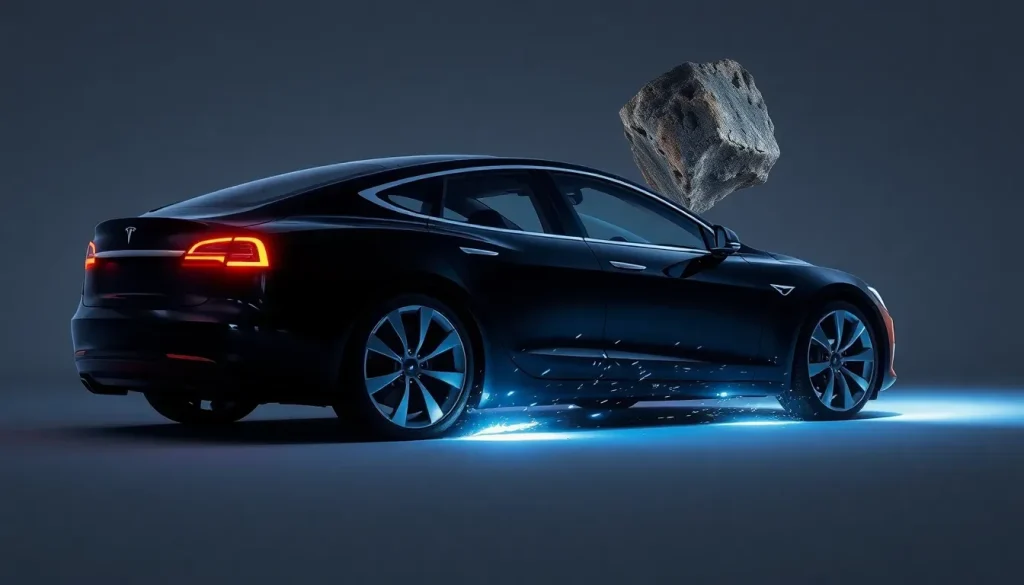
Imagine un escenario donde un coche eléctrico, en modo de conducción automática, se convierte en el escenario de un extraño fenómeno cósmico. Este es el relato de Andrew Melville-Smith, un veterinario australiano, quien, junto a su esposa, vivió una experiencia inolvidable al escuchar un fuerte estallido mientras conducía su Tesla. Lo que ocurrió a continuación desataría una serie de preguntas sobre la naturaleza del objeto que impactó su vehículo y las implicaciones de dicho evento. ¿Podría haber sido un meteorito? La respuesta podría ser más intrigante de lo que parece.
The unusual incident of the Tesla
While driving along a highway in Australia, Andrew Melville-Smith and his wife were startled by a loud and violent explosion. Suddenly, shards of glass filled the interior of their Tesla, and a cloud of white smoke engulfed them. Despite the chaos, the car, operating in autopilot mode, continued to drive as if nothing had happened. Once they managed to regain control and park the vehicle nearby, they discovered that something had struck the windshield, rendering it partially melted.
The melted glass suggests that whatever impacted the car did so at a considerable speed, generating enough heat to affect the windshield as if it were in an oven. Given the circumstances, the couple decided to submit the Tesla for analysis at the South Australian Museum, where a team of experts would investigate whether the object was indeed a meteorite.
If confirmed, this would mark the first documented incident of a meteorite striking a moving vehicle. Previous cases, such as a notable incident in 2023, involved cars that were parked when impacted.
How can we determine if it was a meteorite?
A meteorite is defined as any rocky fragment from a celestial body that falls to Earth. Surprisingly, these occurrences are more frequent than one might think. Each year, approximately 5,200 tons of such fragments descend upon our planet. Most of them disintegrate upon entering the atmosphere, making them too small to be observed, while some manage to reach the ground as relatively larger rocks.
- Typically, meteorites burn up during atmospheric entry.
- Most meteorites remain cold upon impact.
- High-speed impacts generate significant heat, which can melt surrounding materials.
- Scientists analyze potential rock fragments embedded in damaged areas.
- Finding a meteorite requires a search in the vicinity of the impact.
The initial analysis by scientists at the museum would involve examining any potential rock fragments embedded in the glass. If their findings align with meteorite characteristics, they would then proceed to search the area where the impact occurred.
What makes meteorites so intriguing?
Meteorites captivate not only scientists but also enthusiasts of space phenomena. These celestial objects provide invaluable insights into the formation of our solar system. The study of meteorites can reveal:
- Information about the early solar system conditions.
- Clues about planetary formation and evolution.
- Insights into the composition of celestial bodies.
- Data regarding the history of collisions in space.
For researchers, each meteorite can be a time capsule, containing materials that have remained unchanged for billions of years. This aspect makes the ongoing investigation of the Tesla incident particularly significant, as it could contribute to our understanding of cosmic matter.
Other similar cases beyond the Tesla incident
This event has drawn attention not only due to the unusual circumstances of the Tesla continuing its journey but also because of the dramatic situation the passengers found themselves in. In 2023, a similar incident occurred in Strasbourg, where a parked Renault Clio was discovered with a large, smoking hole in its roof. The edges of the hole were burned, yet no trace of the object responsible for the damage could be found.
In this case, some speculated that a meteorite had disintegrated upon impact. Others considered the possibility of space debris as a culprit. The ambiguity surrounding the origin of the object striking the Tesla mirrors the uncertainty faced in similar incidents. It raises questions about the nature of the space objects we encounter:
- Could it have been space debris, such as an old satellite?
- Was it a terrestrial rock propelled at high speed?
- Or was it indeed a fragment from outer space?
Regardless of the origin of the collision, it is safe to say that Andrew Melville-Smith and his wife were remarkably fortunate. Had the object penetrated the glass, their story could have taken a much darker turn.
The implications of meteorite impacts on modern technology
This incident raises vital questions about the safety of modern vehicles in the face of unexpected celestial events. As our reliance on technology grows, so does the vulnerability of our devices to external forces. The collision between a meteorite and a moving vehicle has broader implications for:
- The engineering of vehicle structures to withstand unforeseen impacts.
- Insurance policies covering damages from rare cosmic events.
- The public's awareness and preparedness for similar occurrences.
As we delve into the atmosphere and the realm of space, the potential for such encounters becomes a topic of interest for engineers and policymakers alike. Understanding these phenomena can guide safety regulations and innovations in vehicle design.
For those intrigued by this peculiar incident, you can view a detailed account through this video, which explores the impact on the Tesla and the surrounding circumstances:
In conclusion, the incident involving the Tesla serves as a reminder of the unpredictable nature of our universe and how it can intersect with our daily lives. The investigation into whether a meteorite indeed struck the vehicle will not only provide answers for the couple but may also contribute to our collective knowledge of cosmic interactions.



Leave a Reply