
Toshiba showcases technology for 12-platter disk drives
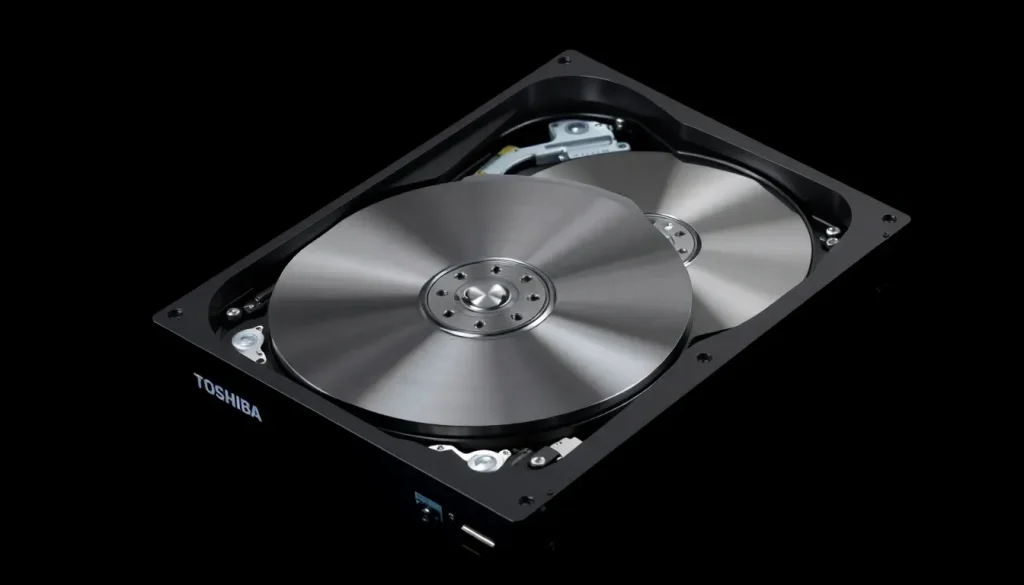
Toshiba has recently unveiled a groundbreaking advancement in hard disk drive technology, showcasing its 12-platter disk drive system. This innovative design not only enhances data storage capacity but also sets new benchmarks in the competitive landscape of data storage solutions. As the demand for data storage skyrockets, understanding the implications of this technology becomes increasingly vital for both consumers and businesses.
With the advent of Toshiba’s 12-platter technology, the storage capacity has seen a significant leap of **20 percent** compared to its previous 10-platter designs, which employ microwave-assisted magnetic recording (MAMR) technology. This enhancement is particularly noteworthy as it reflects Toshiba's commitment to meeting the growing data demands of modern applications, especially in the era of artificial intelligence and cloud computing.
Understanding the Mechanics of Toshiba's 12-Platter Drive
The introduction of the 12-platter disk drive means that Toshiba is pushing the envelope in hard disk design. Traditionally, hard drives have utilized 10 platters, but the new design integrates two additional platters within the standard 3.5-inch enclosure. This necessitates the use of thinner platters and the addition of four more read-write heads—one for each extra surface. This innovative approach allows Toshiba to maximize storage capacity without significantly increasing the physical size of the drive.
Some key features of the 12-platter technology include:
- Enhanced Capacity: The new drives are designed to push the envelope with capacities approaching 28.8 TB for conventional drives and 33.6 TB for shingled drives.
- Thinner Platters: This design requires the development of thinner, more efficient platters to maintain the integrity of the drive.
- Increased Read/Write Efficiency: With additional heads, the drives can handle more data simultaneously, improving overall efficiency.
The Competitive Landscape: Toshiba vs. Seagate
The competition in the hard disk market is fierce, with companies like Seagate and Western Digital also innovating rapidly. Seagate's heat-assisted magnetic recording (HAMR) technology has been in development for years and is expected to provide a capacity of 40 TB by the end of the year, which puts Toshiba at a slight disadvantage as they aim for a 40 TB-class drive by 2027.
Significant differences between Toshiba and its competitors include:
- Density per Platter: Seagate achieves 3 TB per conventional platter, compared to Toshiba's 2.4 TB.
- Shingled Technology: Seagate's shingled drives can reach 3.6 TB per platter, while Toshiba's capacity is 2.8 TB.
- Future Prospects: Both companies are exploring advanced technologies to increase capacity further; Toshiba is looking into next-generation HAMR in conjunction with its 12-platter design.
The Role of Recording Technologies in Hard Drives
Toshiba’s announcement also highlights the importance of proven recording technologies. MAMR technology uses microwaves to enhance the writing process on the platter surface, which has been a significant factor in improving data density and reliability. In contrast, HAMR technology, developed by Seagate, uses heat to assist in the magnetic recording process, enabling even higher data densities.
Each of these technologies holds unique advantages and disadvantages:
- MAMR: Effective for current manufacturing processes and offers scalability with existing technology.
- HAMR: Promises higher data density but has faced challenges in verification and implementation.
Market Implications and Future Trends
The introduction of Toshiba's 12-platter HDD is designed to meet the escalating demand for storage solutions driven by cloud computing, big data analytics, and AI applications. As data generation continues to surge, the need for reliable and high-capacity storage becomes increasingly crucial.
In the coming years, several trends are expected to shape the hard disk drive market:
- Increased Demand for High Capacity: As global data generation continues to grow exponentially, so will the need for drives with higher storage capacities.
- Advancements in Recording Technologies: Continuous improvements in MAMR and HAMR technology will define the competitive landscape.
- Sustainability and Energy Efficiency: Future designs will also focus on reducing energy consumption and improving the sustainability of production processes.
Showcasing Technology and Future Developments
Toshiba is set to showcase its 12-disk stacking technology at the IDEMA Symposium on October 17 in Kawasaki, Japan. This event will provide an opportunity for industry professionals to gain insights into Toshiba's innovations and the future of hard disk technology.
As the industry evolves, Toshiba remains committed to pushing the boundaries of data storage technology. By integrating advanced recording techniques and innovative designs, they aim to capture a significant share of the market and meet the data storage needs of tomorrow.
For those interested in a deeper look, you can check out this insightful video on the future of hard drives:


Leave a Reply